Technical Marketing Report
Abstract
This report outlines the core strategies and execution steps for building a high-performing Google Ads campaign. It covers campaign objective setting, keyword selection, ad creation, performance monitoring, and optimization. Applying modular, data-driven techniques and aligning each phase with business objectives enables advertisers to maximize reach, minimize cost-per-click (CPC), and achieve meaningful conversion rates.
1. Introduction
Google Ads offers one of the most precise and scalable tools for reaching target audiences online. Yet, running ads without a strategic framework often leads to wasted spend and poor performance. This report provides a systematic process for building, launching, and optimizing effective Google Ads campaigns.
2. Campaign Planning Framework
2.1 Objective Selection
The campaign goal should guide every decision — from keyword strategy to bid structure. Typical goals include:
- Brand awareness
- Lead generation
- Direct sales
- App downloads
Using SMART criteria (Specific, Measurable, Achievable, Relevant, Time-bound) helps ensure clarity and direction.
3. Keyword Strategy
Keywords are the foundation of Google Ads. Effective targeting involves:
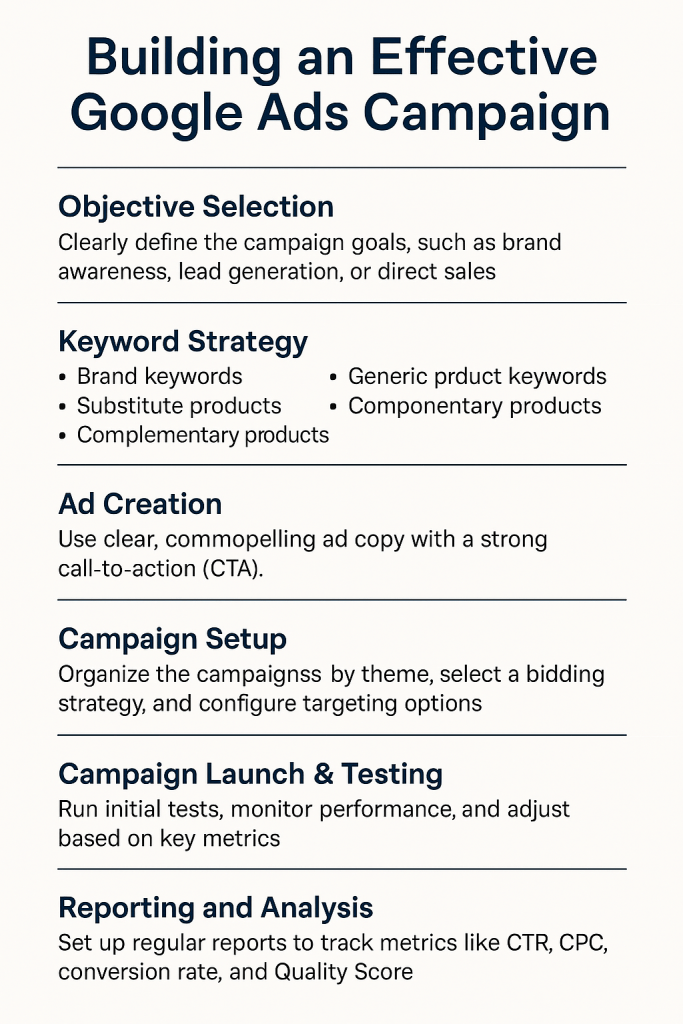
3.1 Categorization (based on uploaded image structure):
- Brand Keywords: e.g., “Nike running shoes”
- Generic Product Keywords: e.g., “men’s running shoes”
- Competitor Keywords: e.g., “Adidas UltraBoost”
- Substitute Products: e.g., “training sneakers”
- Complementary Products: e.g., “shoe insoles”
Use Google’s Keyword Planner to estimate search volume, competition level, and suggested bids.
4. Ad Creation
Effective ad copy has high relevance, clarity, and a compelling Call-To-Action (CTA). Structure:
- Headline: Includes keyword + emotional hook.
- Description: Value proposition and CTA.
- Display URL: Reinforces brand/trust.
- Ad Extensions: Use sitelinks, callouts, and structured snippets for richer info.
A/B test multiple ad variants per group to determine the best performer over time.
5. Campaign Setup
5.1 Structure
- Break campaigns by theme or intent (e.g., by product line, region, or funnel stage).
- Use tightly themed ad groups with 5–10 keywords each.
5.2 Bidding Strategy
Options include:
- Manual CPC (for control)
- Maximize conversions (for speed)
- Target CPA/ROAS (for budget optimization)
5.3 Location and Device Targeting
Adjust bid modifiers based on geography, device usage, and time-of-day performance.
6. Landing Page Integration
Ad performance is tightly coupled with landing page experience. Optimize by:
- Matching page copy to ad text
- Reducing friction (fast load, clear CTA, mobile responsive)
- Tracking via UTM parameters and Google Analytics
7. Campaign Launch & Testing
Use a phased rollout:
- Phase 1: Run ads with default settings and broad keyword match to gather data.
- Phase 2: Apply filters, exclusions, and keyword refinement.
- Phase 3: Launch split tests (ad copy, CTA, bid strategy, landing page variants).
Monitor Quality Score and adjust based on impressions, CTR, CPC, and conversion rate.
8. Monitoring and Optimization
Post-launch, focus on metrics and iterative improvement:
| Metric | Purpose |
|---|---|
| CTR | Relevance of ad to keyword |
| CPC | Efficiency of spend |
| Conversion Rate | Effectiveness of landing page/ad offer |
| Quality Score | Google’s indicator of ad experience |
| Impression Share | Visibility relative to competition |
Optimize using:
- Negative keywords
- Adjusted bids by time, location, or device
- Rotation settings and performance thresholds
9. Reporting and Analysis
Set up automated reporting (weekly or monthly). Include:
- Spend vs. conversions
- Best and worst performing ads
- Keyword match type performance
- Landing page bounce rates
Use Google Data Studio for visualization and easier interpretation by stakeholders.
10. Conclusion
An effective Google Ads campaign is not set-and-forget. It requires continuous monitoring, structured experimentation, and alignment with broader marketing goals. By applying this technical process — from objective setting through to reporting — advertisers can achieve better ROI and sustained growth through Google’s advertising ecosystem.
 DRONΕ AD$
Leave a comment